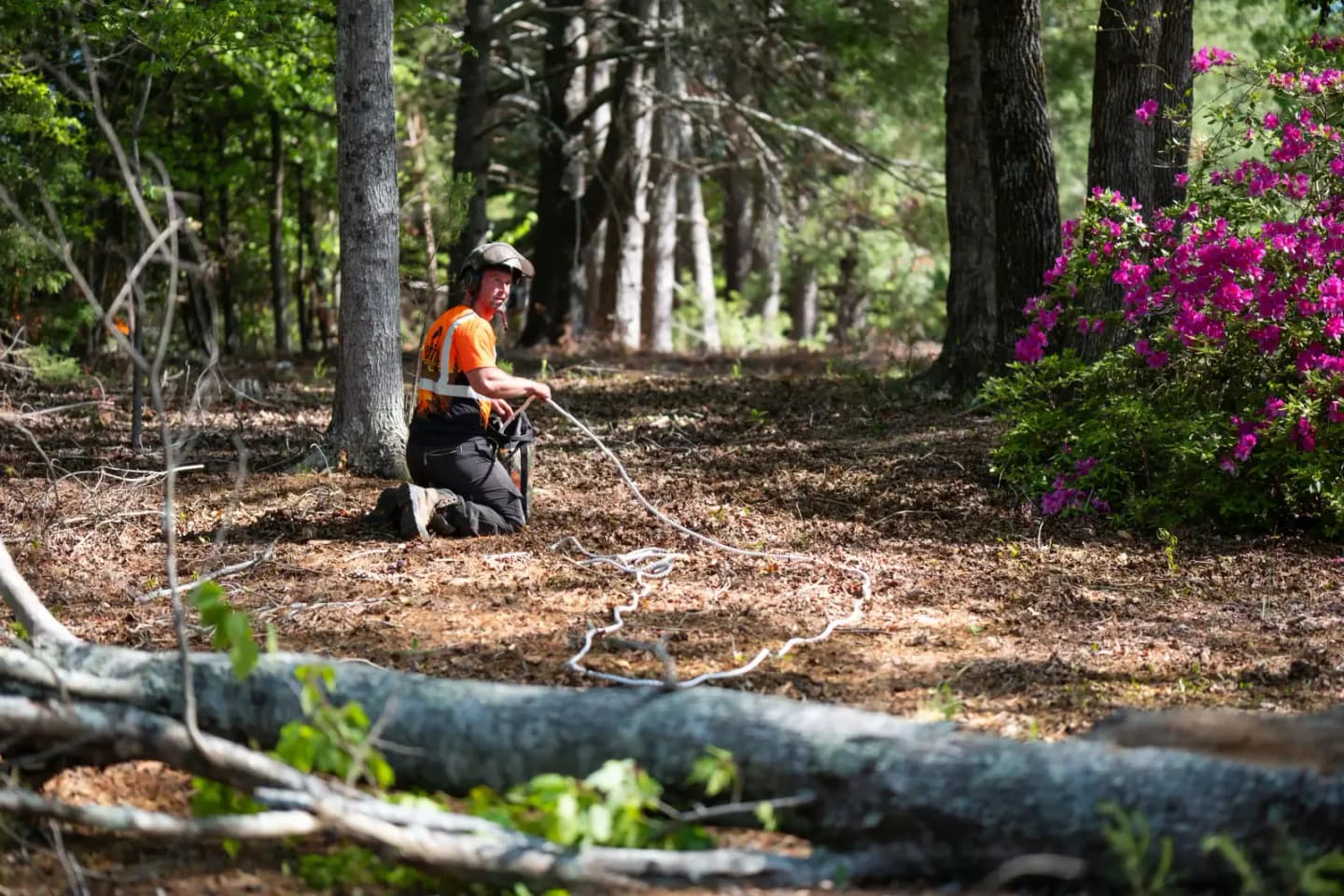

Published May 22, 2026
DIY tree removal causes an estimated 80+ deaths annually in the US and thousands of serious injuries, mostly from chainsaw kickback, falling limbs, and tree falls in unintended directions. The situations that seem manageable from the ground — a dead pine, a leaning oak — are the ones that kill people. Professional removal for a mid-sized tree runs $400–$900. A hospital stay costs more.
Mistake 1: Underestimating Where the Tree Will Fall
A tree's lean, root mass, and crown weight don't always point in the same direction. A tree that appears to lean away from your fence may have a crown that's loaded toward it. Experienced tree crews assess the lean, crown distribution, and root system before planning the fall direction. They use wedges, rigging lines, and sometimes a crane to control the descent. A homeowner with a chainsaw and a rope can't replicate this — and when the tree goes the wrong direction, the fence, the car, or the corner of the house is in the way.
Mistake 2: Chainsaw Kickback
Chainsaw kickback is the primary cause of DIY tree removal injuries. Kickback occurs when the tip of the bar contacts something and the saw rotates back violently toward the operator — faster than human reaction time. It happens most commonly when cutting overhead, when the bar tip catches a branch, and when the saw binds in a cut. Kickback injuries to the face, neck, and arms are severe. Tree professionals use kickback-resistant saws, chain brakes, and specific cutting techniques that reduce exposure. The protective gear alone — helmet, face shield, chaps, boots — costs $400–$700 before you buy the saw.
Mistake 3: Failing to Account for Spring Poles
A spring pole is a branch or trunk under tension that snaps violently when cut — like a compressed spring releasing. Trees that have fallen on other objects, branches that are bent under weight from above, and root balls that are partially uprooted all create spring pole situations. Cutting a limb that's under tension without identifying the tension first sends the cut end moving at high speed in an unpredictable direction. Spring poles kill experienced loggers with decades of experience. They kill homeowners more.
When DIY Is and Isn't Reasonable
Reasonable DIY scope: a small ornamental under 15 feet in an open yard with clear fall zone, no structures within 1.5 tree heights in any direction. Not reasonable: anything dead (unpredictable wood failure), anything over 20 feet, anything within fall distance of a structure, fence, or utility line, anything with visible lean, cavity, or disease. The cost comparison: a homeowner's insurance deductible after a tree goes through a fence is $1,000–$2,500. Professional removal of the tree that caused it runs $400–$700. The math is clear.
Ready for a free written estimate?
We visit your property, evaluate the work, and gives you a written price before anything starts. ISA Certified Arborist. No pressure.
Get Free Estimate