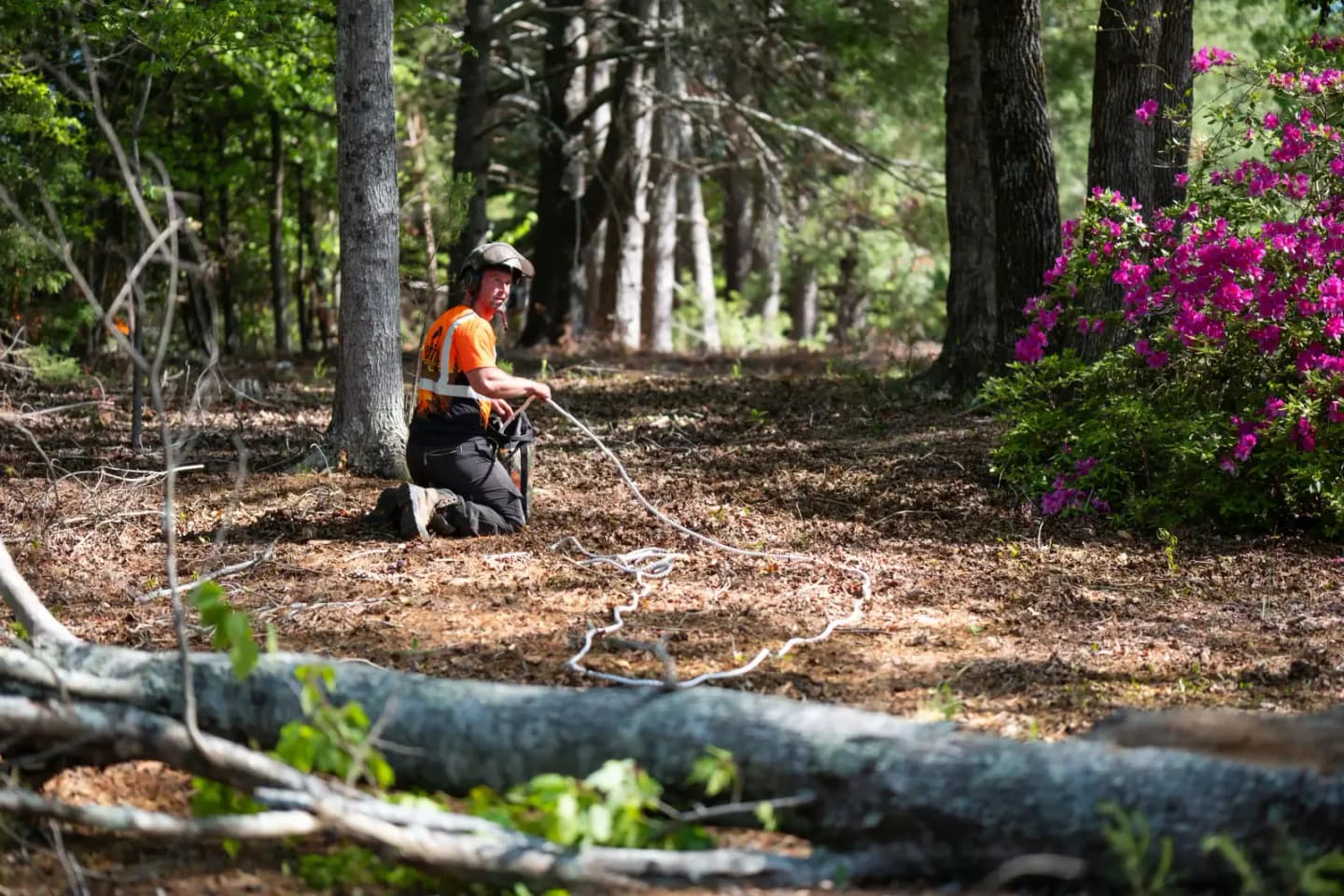

Loblolly pine (Pinus taeda) was widely planted in Upstate SC residential developments from the 1970s through 2000s. Those trees are now 30–70 feet tall and aging into the period when root plate failure and beetle attack are most common. A 60-foot loblolly pine landing on a house causes serious structural damage. Removal before failure runs $800–$1,800 for most residential specimens; emergency removal after failure costs more.
Loblolly Pine — Quick Facts
How to Identify Loblolly Pine
- Long needles (6–9 inches) in bundles of 3
- Reddish-brown scaly bark in mature trees, darker and more plated with age
- Cylindrical cones 3–5 inches long with prickles at scale tips
- Straight main trunk with open, irregular crown at maturity
- Rapid height growth — can reach 50 feet in 20 years in Upstate SC conditions
Root Plate Failure: Loblolly Pine's Primary Risk
Loblolly pine's failure mode is root plate separation — the entire root system, with the tree attached, tilts and lifts from the ground rather than the trunk breaking. This happens because loblolly has a relatively shallow, plate-like root system (as opposed to a deep taproot) that can lose its grip in saturated soils during wind events. The failure is dramatic: the tree falls over nearly intact with a large root ball attached. In Upstate SC's red clay, which becomes heavy and plastic when saturated, root plate separation events are most common during tropical remnant storms that deliver extended rainfall followed by wind. Trees within fall distance of structures warrant annual inspection for root zone changes.
Southern Pine Beetle: The Mass Attack Problem
Southern pine beetle (Dendroctonus frontalis) is the most destructive bark beetle attacking loblolly pine in Upstate SC. The attack pattern: beetles overcome the tree's pitch defenses by attacking in mass — hundreds of individual beetles attack a single tree within a short window, overwhelming the resin flow that normally kills individual attackers. Signs of active attack: pitch tubes (round resin masses pushed through bark entry holes, typically 1/4 inch diameter), reddish-brown boring dust in bark crevices, and yellowish to brown needles starting in the upper crown. An actively attacked pine that has gone fully brown should be removed promptly — dead pine sheds large brittle limbs within months, and the standing dead tree becomes a hazard faster than most other species.
When to Remove vs. When to Monitor
Remove immediately: any loblolly pine that has been mass-attacked by beetles (brown crown, pitch tubes throughout); any pine with dead crown exceeding 50% of the total crown; any pine showing active root plate movement (soil heaving, visible tilt change). Monitor with annual inspection: healthy pines within fall distance of structures; pines showing early beetle activity limited to one section. The economics of loblolly pine removal: a healthy 60-foot pine runs $800–$1,800 to remove proactively. After it falls on a structure, you're looking at $2,000–$5,000+ for the tree plus whatever the structure repair costs. Our ISA Certified Arborist evaluates each pine on-site to weigh removal against monitoring.
Loblolly Pine Pruning and Maintenance
Loblolly pine requires minimal pruning under normal conditions. Crown clearance pruning — raising the lower crown away from structures and vehicles — is appropriate for trees over structures or driveways. The ideal pruning window in Upstate SC is late fall through early spring (October–February) when bark beetle activity is lowest. Fresh pine wounds in summer attract IPS beetles and, in areas with active southern pine beetle pressure, can increase attack risk. Dead branch pruning has no seasonal restriction. Do not remove more than 25% of the live crown in a single pruning event — excessive crown removal stresses the tree and reduces its ability to defend against bark beetle attack.