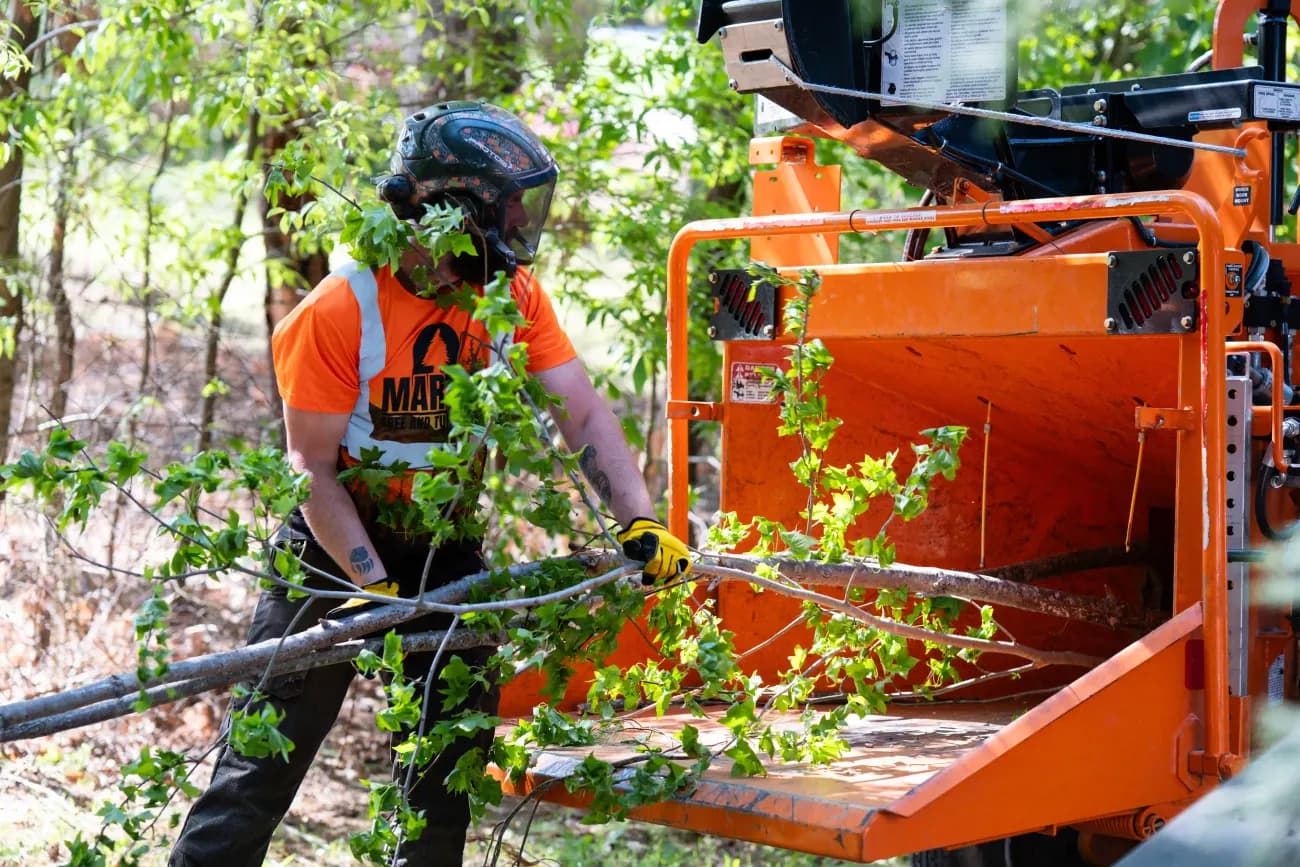

Why do tree companies give wood chips away for free?
Because dumping them costs money. Every removal and pruning job fills a chip box, and that material has to go somewhere — usually a disposal or composting yard that charges by the load, plus the drive time to reach it. Dropping a load at a house two miles from the job is cheaper than hauling it twenty miles to a yard and paying a tipping fee at the end.
That is the entire economics of it, and it is worth understanding because it explains the terms. Chips are free, but they arrive on the tree company's schedule rather than yours, because the saving only exists when the drop is on the way. It also explains the minimum load: splitting 15 cubic yards across two addresses means two stops, and the second stop erases the saving.
It is a genuinely mutual arrangement rather than a promotion. You get mulch you would otherwise buy; the crew avoids a disposal fee and a round trip.
What is in a load of fresh wood chips?
Chipped wood, bark, leaves, and small sticks, mixed together in whatever proportion came off the job. Piece size runs from sawdust to chunks a few inches across. Nothing is screened, dyed, sorted, or composted. It looks rougher than bagged mulch, and the mix of particle sizes is exactly why it performs better than bagged mulch on beds.
That variation is a feature. Fine material fills gaps and holds moisture; coarse pieces keep the layer open so water and air still reach the soil; leaves and green material break down fast and feed the soil biology early. Uniform bagged product does none of that as well.
Species depends entirely on where the job was. In Upstate SC that means oak, tulip poplar, and hickory out of established neighborhoods; loblolly pine out of the pine belt; and a lot of ornamental pear out of subdivisions built fifteen to twenty years ago that are now hitting their structural failure age.
How deep should wood chips go?
Three inches. That is the standard depth for beds and tree rings in Upstate SC. Thinner than that dries out too fast in July and does not suppress weeds. Thicker than four inches starts limiting oxygen to the roots and holds enough moisture to encourage fungal problems at the soil surface. Three inches is the number to aim for; four is the ceiling.
The other rule matters more than depth: keep chips six inches back from any trunk. Mulch piled against bark holds moisture against it, and bark that stays wet decays. Those "mulch volcanoes" around street trees are one of the most common avoidable causes of decline. Leave the root flare visible — you should be able to see the trunk widen where it enters the ground.
Keep mulch at least twelve inches back from a house foundation too. Not because chips attract pests, but because any deep, damp layer against a foundation gives insects a sheltered route in.
Do fresh wood chips steal nitrogen from plants?
Only at the thin layer where chips touch soil, and only if you till them in. Decomposing wood needs nitrogen, and the microbes doing the work take it from whatever is immediately adjacent. On the surface, that is a half-inch interface far above the root zone, and established plants never notice. This is the single most misunderstood thing about fresh chips.
Tilling them into the soil is the actual mistake. Then decomposition is happening throughout the root zone, competing directly with your plants, and you will see yellowing within a season. The fix is simply never to do it: chips are a surface mulch, not a soil amendment. Spread them on top and leave them there.
The one case worth care is direct-seeding into a freshly chipped bed. Seedlings have shallow roots right at that interface layer. Wait until seedlings are up and established, then mulch around them.
Are black walnut chips safe to use?
For most plantings, yes. For a vegetable garden, exclude them. Black walnut produces juglone, a compound that inhibits growth in sensitive species. The ones gardeners notice are tomatoes, peppers, eggplant, and potatoes — the nightshades — which can wilt and decline near walnut material.
Most ornamentals, grasses, shrubs, and trees tolerate juglone without trouble, and it breaks down as the material decomposes, so well-composted walnut is largely a non-issue. Fresh chips are the concern, not aged ones. Since you cannot tell walnut from other hardwood by looking at a chip pile, the practical move is to check the black walnut exclusion when you request a load for a vegetable garden.
Which plants should not get fresh wood chips?
Seed beds, young seedlings, and anything in the nightshade family if the chips may contain black walnut. Everything else — trees, shrubs, perennials, established vegetables, paths — takes fresh chips fine as a surface layer.
A few situations call for judgment rather than a rule. Moisture-sensitive plantings like lavender, rosemary, and most Mediterranean herbs prefer a thinner layer or a gravel mulch, because chips hold more water than they want. Very wet, poorly drained sites do not need help retaining moisture either. And in a bed where you actively want self-seeding annuals to come back, a 3-inch chip layer will suppress them along with the weeds.
Fresh chips around newly planted trees are actively good — that is one of the best uses for them. Just observe the six-inch trunk clearance. Our tree planting page covers establishment care in more detail.
Do wood chips spread disease or weed seeds?
The risk is low and manageable. Most tree pathogens are host-specific and live in wood or roots rather than surviving on the surface of a chip pile, and a mulch layer is not a route into a healthy tree's vascular system. Weed seed is the more realistic concern, since chips include whatever ground-level growth went through the chipper with the brush.
Two practical precautions cover it. First, a proper 3-inch layer suppresses far more germination than it introduces — thin layers are what let weeds through. Second, if you are mulching around a tree species you are actively worried about, ask that chips from that species be excluded. Requests around specific tree diseases are worth raising when you submit the form.
One genuine exception: do not use chips from a tree removed for a soil-borne root disease around susceptible hosts. If a crew is removing a tree for that reason, they will normally say so.
Free wood chips vs. buying bulk mulch: which is better?
Free chips win on cost and soil benefit; bought mulch wins on appearance and on arriving when you want it. Which matters more depends entirely on where it is going. For a back bed, a path, an orchard, or around trees, free chips are the better material as well as the cheaper one. For a formal front bed people look at, bought mulch looks tidier.
The mixed particle size that makes fresh chips look rough is the same property that makes them better for soil — they break down at different rates, feeding soil biology over a longer period than uniformly shredded bark. Dyed mulch, at the other end, is generally ground pallet wood with colorant and contributes little.
The real trade-off is control. Bought mulch is delivered on a date you choose, in the species and grind you choose. Free chips arrive when a crew is nearby, in whatever species that job produced. If you have a deadline, buy. If you have patience and a spot for the pile, take the free load. Run your area through the mulch coverage calculator to see what you would be spending.
How many loads of wood chips do you need?
One load for most residential yards. A load is roughly 15 cubic yards, which covers about 1,600 square feet at 3 inches deep. To work it out for your own space: multiply length by width for square footage, multiply by 0.25 for a 3-inch depth, then divide by 27 to get cubic yards.
A 20-by-30-foot garden is 600 square feet, or about 5.6 cubic yards — well under one load. A quarter acre of beds and paths runs past two. The load calculator on the request page does the arithmetic and tells you how many free loads that comes to.
Plan for the surplus before requesting. The minimum drop is 10 cubic yards, so a small bed still gets a full pile. Chips keep indefinitely in a heap and shrink as they settle, so a surplus is a storage question rather than a waste one.
Where can you get free wood chips in Upstate SC?
Martin Tree and Turf Care delivers free chip loads across the Upstate service area. Request a load on the free wood chips page, or start with the page for your city — each one lists the species mix and drop conditions specific to that area.
- Free Wood Chips in Greenville, SC
- Free Wood Chips in Greer, SC
- Free Wood Chips in Spartanburg, SC
- Free Wood Chips in Simpsonville, SC
- Free Wood Chips in Taylors, SC
- Free Wood Chips in Easley, SC
- Free Wood Chips in Travelers Rest, SC
- Free Wood Chips in Mauldin, SC
- Free Wood Chips in Anderson, SC
- Free Wood Chips in Five Forks, SC
- Free Wood Chips in Powdersville, SC
- Free Wood Chips in Fountain Inn, SC
Already having tree work done? You do not need to request a load at all — tell us at the estimate that you want the chips left on site, whether the job is tree trimming, removal, or land clearing.
Free Wood Chips — Common Questions

Written by
Martin Tree and Turf Care
James Martin is an ISA Certified Arborist (SO-356834A) and a Tree Climbers International Certified Tree Technician. He reviews the tree care guides published by Martin Tree and Turf Care for technical accuracy.
Reviewed by James Martin, ISA Certified Arborist #SO-356834A
Updated September 3, 2026
About James →