Published July 7, 2026
Doing your own tree removal is reasonable for a small tree — under about 25 feet, well away from any structure or power line, with clear space to drop it and no climbing required. Above that, hiring a pro stops being about convenience and starts being about liability. A tree near a house, over a fence, or anywhere close to a power line can cause damage or injury that dwarfs the few hundred dollars you'd save. The part most homeowners miss is insurance: if an uninsured helper is hurt on your property, you can be the one who pays. Removal by a licensed crew in Upstate SC runs $400–$2,500+; the DIY savings vanish fast when something goes wrong.
Should You Remove a Tree Yourself or Hire a Pro?
Start with three questions: How tall is it? What's within its reach if it falls wrong? And do you have to leave the ground to cut it? A 15-foot ornamental in an open yard you can fell in one cut is a reasonable DIY job with the right saw and a helper. Anything tall enough to reach a roof, fence, or power line — or anything that requires a ladder or climbing — belongs to a crew with the equipment, training, and insurance to handle a mistake. The honest line isn't 'never DIY.' It's 'know exactly where DIY stops being worth it,' because tree work is one of the most dangerous jobs there is and the failure modes are severe.
When DIY Tree Removal Is Reasonable
There are jobs a capable homeowner can handle safely. A small tree or large shrub under about 25 feet, growing in the open with a clear drop zone twice its height in every direction, no structures, fences, or lines within reach, sound wood (not dead, rotted, or leaning), and a straightforward fell that needs no climbing. For those, a sharp chainsaw, eye and ear protection, chaps, a helper spotting, and a planned escape path are enough. Renting a chipper or paying for haul-off handles the cleanup. If your tree fits every one of those conditions, doing it yourself is a fair way to save money.
When Hiring a Pro Isn't Optional
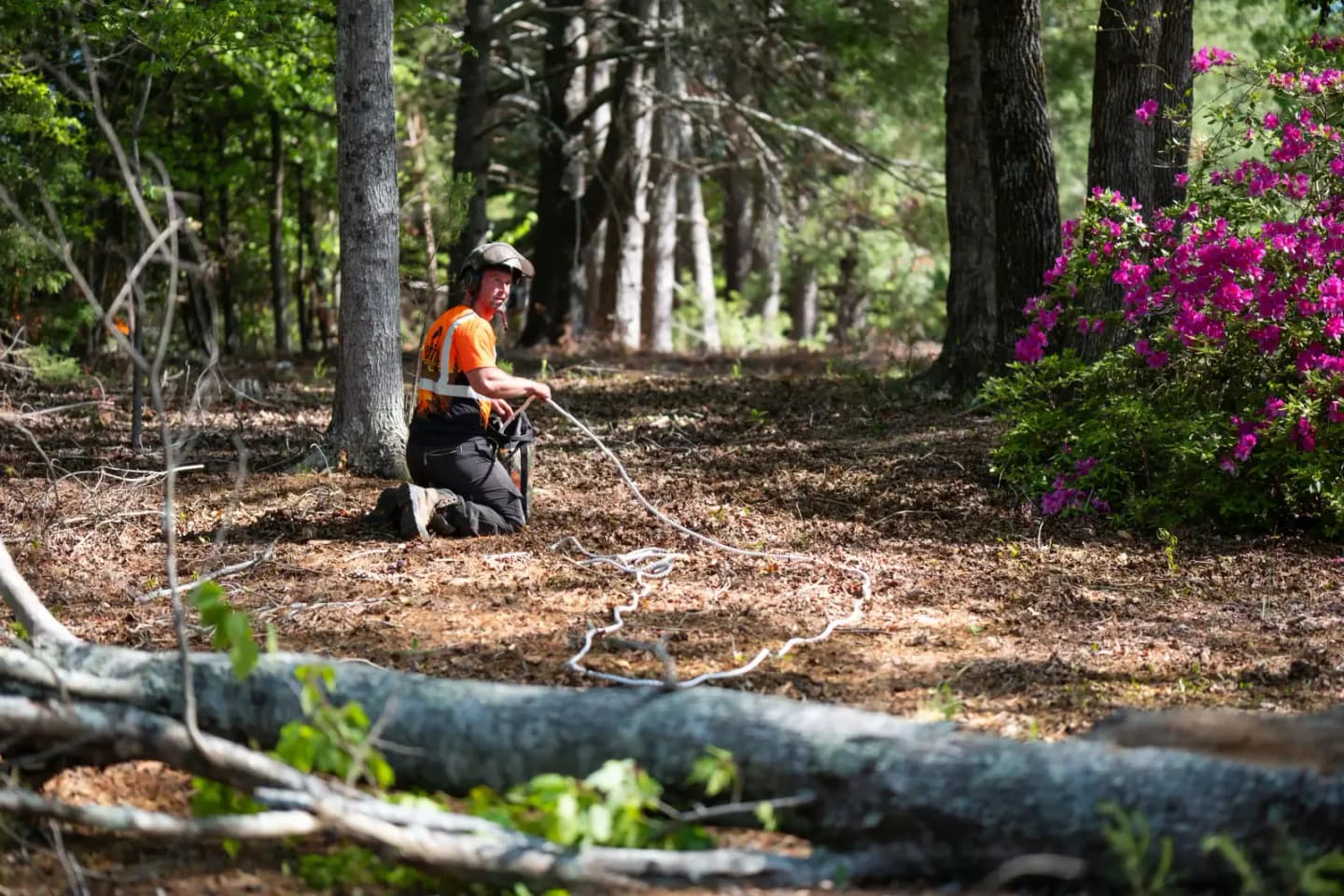
Some removals are not a budget decision — they're a safety one. Hire a crew when the tree is tall enough to hit a structure, is within reach of a power line (only line-clearance-qualified crews and the utility should work near energized lines), is leaning, dead, storm-damaged, or partially uprooted, requires climbing or a bucket to reach, or sits in a tight space where sections must be rigged down instead of dropped. These jobs need rigging, cutting experience, and the ability to control where every piece lands. A homeowner with a rented saw cannot control a 60-foot pine coming down next to a house — and the cost of getting it wrong is the roof, the fence, or someone's safety.
The Insurance and Liability Gap Nobody Mentions
This is the part that turns a small savings into a large risk. If you hire an uninsured 'guy with a truck' and one of his workers is injured on your property, your homeowner's policy — not his — can end up carrying the claim, and homeowner policies often exclude it. A properly insured company carries general liability and workers' compensation, and can hand you a certificate of insurance before work starts. If a licensed crew damages your house, their liability coverage pays. If they hurt themselves, their workers' comp pays. That transfer of risk is a real part of what you're buying, and it's worth far more than the discount an uninsured operator offers.
What You Actually Save — and What You Risk
The DIY savings are real but smaller than they look. A pro removal in Upstate SC runs $400–$1,400 for a mid-sized tree and $1,400–$2,500+ for a large hardwood near a structure. Doing it yourself, you still pay for saw rental or purchase, fuel, protective gear, a chipper rental ($150–$400/day), and dump fees — often $200–$500 before your own time. Against that, weigh the downside: an emergency-room visit, a caved-in roof, a downed power line, or a liability claim. For a small open-yard tree, the math favors DIY. For anything bigger, the professional price is mostly buying you out of a risk you don't want to own.
DIY vs. Professional Tree Removal — Upstate SC
| Factor | DIY | Hire a pro |
|---|---|---|
| Realistic cost | $200–$500 in rentals, gear, dump fees | $400–$2,500+ all-in, quoted on site |
| Insurance | Your homeowner's policy is exposed | Their liability + workers' comp covers it |
| Near a power line | Never — call the utility and a pro | Line-clearance-qualified crews only |
| Cleanup & disposal | You haul or rent a chipper | Debris removed as part of the job |
| Best for | Small open-yard tree, no climbing | Tall, leaning, structure- or line-adjacent |
Never DIY a tree removal if it has any of these
What our arborist sees on site
We'll be straight with you — some trees you don't need us for. A little dogwood in the middle of an open yard, drop it yourself and save the money. But the second that tree can reach your roof or a power line, you're not paying us to cut wood. You're paying us to make sure it lands where it's supposed to and to carry the risk if it doesn't. That's the part a rented chainsaw can't buy.
Cost ranges reflect tree removal jobs completed by Martin Tree and Turf Care across Upstate SC and typical local equipment-rental rates. Actual pricing is quoted after an on-site assessment. Work near energized power lines should always be coordinated with the utility and line-clearance-qualified crews.
Ready for a free written estimate?
We visit your property, evaluate the work, and gives you a written price before anything starts. ISA Certified Arborist. No pressure.
Get Free Estimate